My Rabbit Hole Into AI Content and Copyright
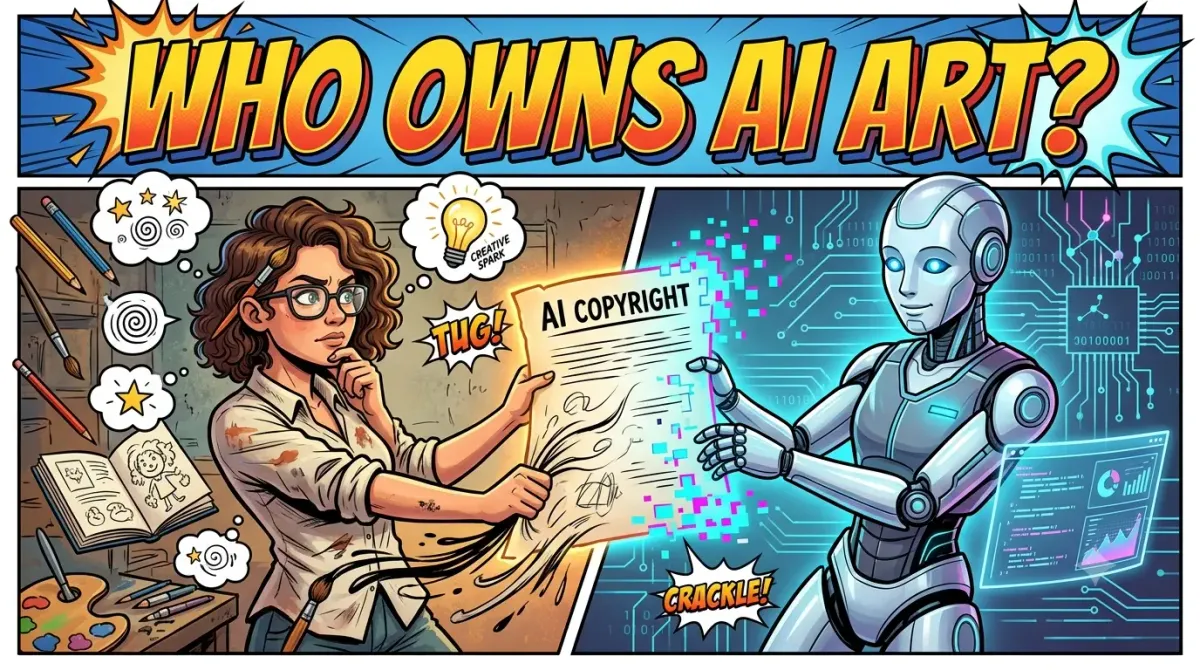
Recently, while exploring generative AI, I randomly came across a question that looked simple at first:
"If AI creates something, who owns the copyright?"
At first, I thought the answer would be straightforward. Maybe the person who generated the content owns it, or maybe the AI company owns it. But after looking deeper, I realized the topic is much more complicated than I expected.
The interesting part is that the problem is not just about AI. It is actually about something much older:
What does it mean to create something?
Is AI the Creator?
One of the first things I discovered is that most copyright systems are built around human creativity.
For hundreds of years, copyright has been about protecting human expression. A person writes a book, paints a picture, creates music, or develops an idea — and the law protects that creative contribution.
But generative AI creates a new situation.
If someone types:
"Generate a beautiful fantasy castle surrounded by mountains"
and gets a finished image, can we really say that the person created the image?
The person had an idea. They gave instructions. But the AI system made thousands or millions of decisions to produce the final result.
This is where things become complicated.
A Prompt Is Not the Same as Creating
One thing that surprised me was learning that a detailed prompt does not automatically mean someone owns the copyright.
A prompt can show creativity, but the final output may still depend heavily on the AI model.
Think about it like asking a photographer:
"Take a beautiful picture of a sunset."
The idea is yours, but the actual photograph depends on the photographer's choices.
AI is obviously different from a human photographer, but the comparison helps explain the challenge.
The question becomes:
How much control and creative contribution does a person need before AI-assisted work becomes their creation?
Human + AI Is a Different Story
The more I explored this topic, the more I realized that the future probably will not be about humans versus AI.
It will be about humans using AI as a creative tool.
For example:
A person who creates:
- the original concept
- the story
- the structure
- the design decisions
- the editing
- the final selection
is contributing much more than someone who only writes a single prompt.
In these cases, AI becomes similar to other creative tools.
A camera does not own a photograph.
Photoshop does not own a digital painting.
A musical instrument does not own a song.
Maybe AI will eventually be viewed in the same way — as a powerful extension of human creativity.
Then I Found the Bigger Question: How Are AI Models Trained?
While exploring copyright, I found another much bigger debate.
Before asking:
"Who owns AI-generated content?"
we also need to ask:
"How was the AI trained?"
Modern AI models learn from huge amounts of data:
- books
- images
- videos
- code
- articles
- many other forms of content
This created a major discussion.
Creators started asking:
"Was my work used to train these models?"
And this is where the situation becomes legally and ethically complicated.
Some people argue that AI learning is similar to how humans learn from existing knowledge.
For example, an artist studies thousands of paintings and develops their own style.
Others argue that AI training is different because machines can absorb and reproduce patterns at a massive scale, potentially affecting the original creators.
I think this is one of the biggest questions AI companies will need to solve.
Copyright Is Not the Only Problem — Trust Matters Too
Another interesting area I discovered is content transparency.
In the future, people may want to know:
- Was this created by a human?
- Was AI involved?
- What parts were generated?
- What tools were used?
This is where ideas like content provenance become important.
Instead of hiding AI usage, creators may be able to provide a creation history:
Original idea: HumanGeneration assistance: AIEditing: HumanFinal decision: HumanPersonally, I think this direction makes a lot of sense.
Transparency creates trust.
The Ethical Side of AI Creation
While researching, I also came across several AI ethics frameworks from organizations like UNESCO, OECD, and NIST.
Even though they approach AI from different perspectives, many of them share similar ideas:
Human Responsibility
AI should assist humans, but humans should remain responsible for decisions.
Transparency
People should know when AI is involved.
Fairness
AI systems should avoid harmful bias and unfair outcomes.
Accountability
Someone should always be responsible for the final result.
My Current View
After going through all these topics, my understanding changed.
Initially, I thought:
"Giving copyright to AI-generated content should be simple. Just give ownership to the person who generated it."
But now I understand why it is not that simple.
AI introduces a new layer between human intention and final creation.
The real question is not:
"Was AI used?"
Because in the future, AI will probably be involved in almost everything.
The better question is:
"What was the human contribution?"
I personally think the future should not focus on proving that AI was not used. Instead, we should focus on creating systems where human creativity, responsibility, and ownership remain clear.
AI can become one of the most powerful creative tools humans have ever created ,but the way we build and use these tools will decide whether they empower creators or replace them.
And that is what makes this topic so interesting.
(These are my thoughts after exploring the topic; laws and standards around AI-generated content are still evolving.)